
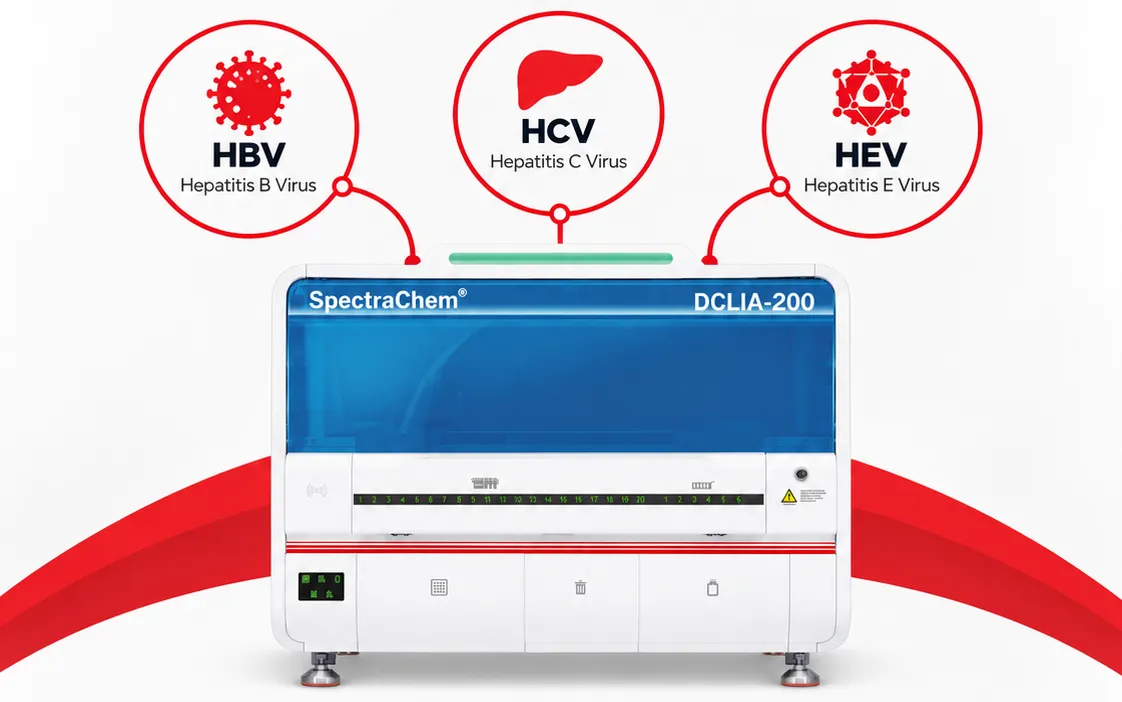
Ask most laboratories in India which hepatitis markers they run as routine, and the answer is the same: HBV and HCV. Both sit in the standard panel. Both get reported without anyone having to think about them.
HEV is the one that gets left out.
Why HEV gets skipped
It is rarely a clinical decision. It is a workflow one. In most laboratories, hepatitis E is not part of the standing panel — it is an add-on, ordered only once a patient presents with symptoms that already point at acute viral hepatitis. That means the test depends on somebody remembering to ask for it.
The consequence is predictable. A patient with jaundice, malaise and raised transaminases gets screened for B and C, comes back negative for both, and the cause goes unexplained — or the investigation restarts days later with a separate request for HEV.
Why it matters more in India
Hepatitis E is transmitted by the faecal-oral route, largely through contaminated water. That makes it seasonal in a way the blood-borne hepatitides are not: incidence rises where water supplies are compromised, and outbreaks are common through the monsoon, when flooding and drainage failures put sewage and drinking water in contact.
So the period when HEV is most likely to be the answer is exactly the period when laboratories are busiest — and when an add-on test is least likely to be remembered.
HEV also carries a particular clinical weight in pregnancy, where acute infection is associated with considerably worse outcomes than in the general population. A missed diagnosis there is not an administrative inconvenience.
Closing the gap is a panel problem, not a testing problem
The fix is not to persuade clinicians to order one more test. It is to stop making HEV a separate decision at all.
The SpectraChem DCLIA-200 runs HBV, HCV and HEV on a single CLIA platform. All three sit in the same panel, on the same analyser, in the same run. There is no separate request to raise, no send-out to chase, and no extra test for anyone to remember — because it is already there.
About the DCLIA-200
- Throughput of up to 200 tests per hour.
- A broad menu of over 270 CLIA test parameters.
- Single reaction cup design, which prevents light pollution and maximises cuvette utilisation.
- Uninterrupted reagent and sample loading, so the system keeps running without pauses between batches.
- Sets a new standard for space efficiency among CLIA analysers.
If your hepatitis panel currently stops at B and C, it is worth asking what the third result would have told you. See the DCLIA-200, or request the datasheet and configuration options through the enquiry form on the product page.
Get a quote
Tell us what your lab needs.
Share your throughput and test menu and we will confirm configuration, reagents and pricing.